You ghosted your email list. Now what?
It's a common tale: sender begins building a list with hope, and then life gets in the way. How do you recover from ghosting your subscribers?
Yesterday, I had an intro call with a solopreneur who'd stopped emailing her list. She'd been running ads to grow it, but when she checked Mailchimp, the majority of the subscribers who came through the ad had never opened a single email.
So she scaled her ads to a dollar a day, stopped sending, and started wondering if she should switch platforms.
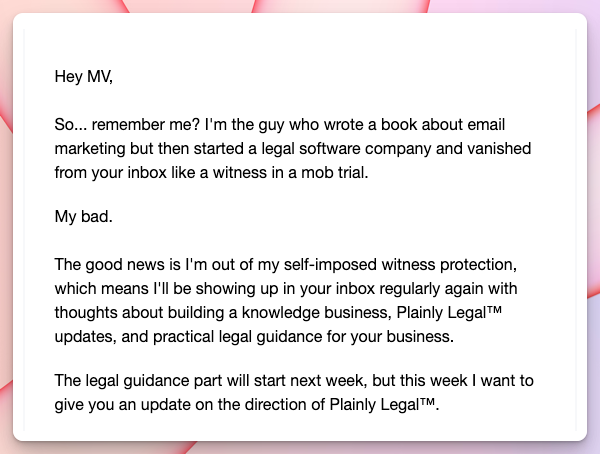
This morning, Bobby Klinck, who literally wrote a book about email marketing, popped back into my inbox after months of silence, joking he'd been in "self-imposed witness protection."
His comeback email was warm and funny and honest. And I probably only saw it because Bobby and I had exchanged emails during his break from marketing sends. His domain never went fully cold with my mailbox provider; he'd kept one relationship alive even while pausing the other.
These two stories illustrate the same thing from opposite ends. Bobby's restart landed because he'd maintained a relationship he wasn't even thinking about. My client's list stalled because a relationship she didn't know existed had quietly broken down, which made her think the problem was her platform or her content.
It was neither. Restarting your list is a relationship decision, not a content decision. And you're accountable to two audiences.
First: should you restart this relationship?
Not every relationship should be rekindled. Before you think about what to write or how to warm up your domain, ask a more honest question: does this list still make sense?
If you have the capacity for consistent sending, even once or twice a month, and your list still matches who you are and what you're doing, then yes. Restart. Email is still the most direct line to people who raised their hand and said they want to hear from you.
If you have a body of work but not the bandwidth for regular writing, an evergreen automated sequence might be more honest than a newsletter you'll abandon again in two months. You might have posts, episodes, or frameworks that could be packaged into a drip sequence that delivers value without requiring you to show up every week. For a lot of solopreneurs, it's a more sustainable relationship than a live newsletter.
If you've pivoted or rebranded, be honest about whether this is even the same relationship anymore. Can you repurpose your existing content for the new direction? Can you segment out the subscribers who'd genuinely be interested?
If the answer to both is no, sunset the list. Starting fresh with zero engaged subscribers is better than dragging 2,000 confused people into something they didn't sign up for.
If yes: you're accountable to two audiences
This is the part most restart advice gets wrong. It treats restarting as one thing: write a good comeback email and you're back.
But you're actually re-entering two relationships at the same time, and they care about completely different things.
Your subscribers care about the human stuff. Do they remember you? Are they glad to hear from you? Are you giving them a reason to stay? This is the relationship most people think about, the "what do I say?" part.
Mailbox providers care about patterns. They don't read your email. They see a domain that's been silent for months suddenly generating a batch of messages, and they decide whether that looks like a returning sender or a compromised account. This is the relationship most people don't think about at all.
The tricky part is these two relationships can pull in opposite directions. The subscriber relationship says send a great re-engagement email to everyone.
The mailbox provider relationship might say don't hit your whole list at once.
How you balance that depends on your list size.
The universal groundwork (every list, every size)
Before you send anything, do a quick infrastructure check. This isn't glamorous but it protects both relationships.
Check your domain authentication. Make sure SPF, DKIM, and DMARC are in place. This is the easiest thing to fix and the most catastrophic if it's broken. Gmail and Microsoft now permanently reject unauthenticated mail instead of just filtering it quietly.
Clean your list. Remove hard bounces, dead addresses, and obvious deadweight. A batch of bounces on your first send tells mailbox providers your list is stale, which is exactly the wrong first impression.
Make sure unsubscribe works. When you show up after a gap, some people will want out. That's healthy. A working one-click unsubscribe means they leave cleanly. A broken or buried unsubscribe link means they hit "mark as spam" instead, and that does real damage.
Expect higher unsubscribes than you're used to. Gmail's one-click unsubscribe feature has roughly doubled unsubscribe rates across the board.
Someone unsubscribing is not a failure. Someone reporting you as spam is.
Restart (by list size)
Under ~250 subscribers
The mailbox provider relationship is a non-issue. Your volume is indistinguishable from normal personal or business email. Forty messages spread across Gmail, Outlook, and Yahoo doesn't register as a pattern. No warmup needed.
Put all your energy into the subscriber relationship. At this size, many people might actually remember you. That's an advantage. Send your comeback email to everyone. Be honest about the gap. Remind them why they signed up. Give them something genuinely useful right now, not a promise that good stuff is coming next week.
250 to 2,000 subscribers
The mailbox provider relationship deserves a light touch. You're not at bulk sender thresholds, but a domain that's been dark for months suddenly pushing 1,000+ emails can look anomalous.
Simple fix: send to your most recently active subscribers first (recent clickers or newest signups), then the rest of the list a few days later. Two sends, not a complex ramp. You're giving mailbox providers a small positive signal before the larger batch.
The subscriber relationship carries the same weight. Be honest, be useful, set expectations. At this size you'll see a noticeable wave of unsubscribes. Don't panic. Let them go.
2,000+ subscribers
The mailbox provider relationship needs deliberate rebuilding. A dormant domain suddenly sending thousands of emails is exactly the pattern that triggers filtering. Ramp over two to three weeks. Start with your most engaged segment — people who opened or clicked in their last active months. Then expand tier by tier. You want strong early signals (opens, clicks, replies) before you reach the less engaged parts of your list.
The subscriber relationship should be segmented too. Your most engaged subscribers get the warm "I'm back, here's what's coming" message. Your least engaged, the people who were already fading before you went quiet, might need a more explicit re-permission email. Something like: "I'm sending again. Here's what to expect. If you're still in, great. If not, no hard feelings."
Anyone who doesn't respond to that is someone you should be removing anyway. It protects both relationships at once.
The thing that matters most at every size
Follow through. The comeback email is the easy part. The second email is harder. The fifth one is where most people drop off again.
Don't commit to a cadence you can't sustain. Weekly is great if you can do it. Biweekly is fine. Monthly is fine. What's not fine is promising weekly and going dark again in six weeks, because next time, both relationships will be harder to repair.
P.S. The solopreneur scheduled a Power Up Hour to get her platform ready for a comeback. Want my help with yours?