I work in email. An email list wouldn’t have saved me.
What happened when LinkedIn suddenly restricted my account and why 'build an email list' isn't enough.
On Tuesday, someone recommended me in a Slack thread asking for email deliverability consultants. They included a link to my LinkedIn profile, which was a reasonable and common credibility marker.
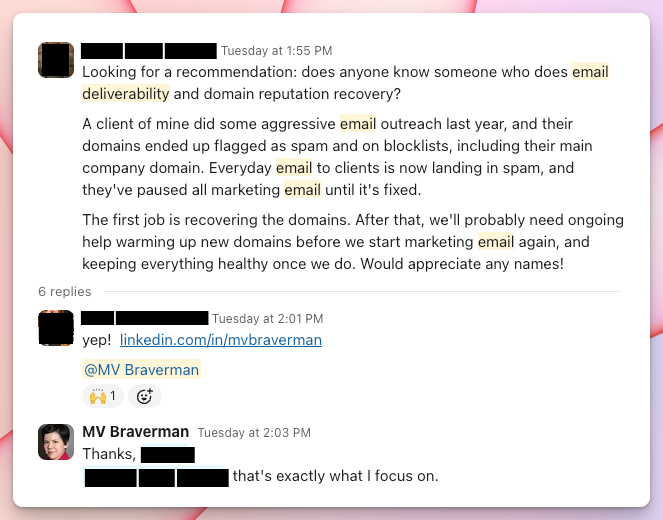
There was just one little problem: a few hours later, that link led to a 404.
My LinkedIn account had been restricted, and I didn’t even know it. My profile and articles still showed up in search, but those results now led nowhere. My website showed up too, thankfully, but anyone following that recommendation would have had to go looking for me.
I’d first noticed something was off when I checked LinkedIn, as I do way too often, and landed on the sign-in screen. Weird, but I moved on with my day. Then I opened the iOS app to keep up my puzzles streak (iykyk) and got the same thing.
Approximately 20 CAPTCHA screens later, I found out that my account had been restricted. The only recovery option I was offered was to submit my government ID through a third-party verification tool called Persona.
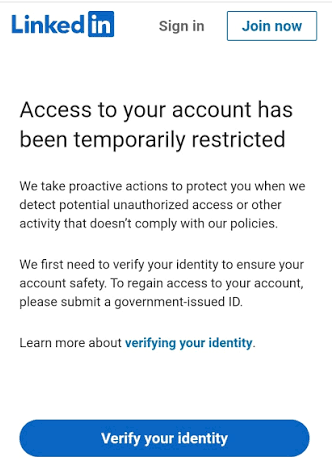
Having recently read Brian Krebs’s reporting on millions of stolen driver’s license scans, I was understandably reluctant. (You should follow Brian Krebs, but maybe not only on LinkedIn). The explanations of who would keep what data, and for how long, were not clear and decidedly not reassuring.
I eventually found a way to file a support ticket asking what had triggered the restriction and whether there was another way to verify my identity. The reply was fast but pointless: another link to submit my ID.
I was ready to keep pushing, but then I thought about that Slack thread. Someone had vouched for me to a roomful of peers and potential clients, and the link they shared now went nowhere.
I could deal with being locked out (though I’d mourn the puzzle streaks), and I would have kept fighting if the only issue had been my ability to publish new things. But other people being unable to see my existing work was a different problem. Plus, since I was the only admin on my business pages, losing my personal account meant losing access to those too.
Reader, despite my principles and protestations, I caved. I submitted my ID, and my account was restored within a couple of hours. I still have no idea what happened and my privacy concerns haven’t been resolved, but the cost of refusing was simply too high.
Why "build your list" isn’t the whole answer
The obvious marketer response is "This is why you need your own email list!"
I work in email deliverability. I give that advice, and I’ll keep giving it. But an email list would not have kept that Slack referral link working.
My LinkedIn newsletter has way more subscribers than my email list, partly because I suck at promoting my list. But there are structural reasons, too: LinkedIn encourages people to subscribe and makes it easy, right where they already encounter my work. Getting someone to leave the platform and sign up somewhere else requires another decision and more effort.
An email list can certainly keep me familiar to subscribers, and a forwarded email can introduce me to someone new. But I can’t make my whole professional network subscribe, and even an equally large list wouldn’t necessarily include the same people or preserve their connections to one another.
LinkedIn is where I stay in touch with people I meet at networking events, get to know friends of friends and peers, and keep conversations going beyond a single introduction. Those relationships matter whether or not anyone ever becomes a client or joins my list. Subscribing to my newsletter and staying connected with me aren’t the same thing.
A backup can preserve what I wrote, but it can’t recreate all the circumstances in which someone might discover it, join the conversation, or recommend me to someone else. And it can’t fix a LinkedIn link someone has already shared, which is exactly what broke in that Slack thread.
Locked out is not the same as hacked
Protect your accounts: use 2FA and passkeys, unique email addresses, and strong passwords. But there’s a difference between someone breaking into your account and the platform deciding it will no longer let you in. Securing your account against the former doesn’t protect you from the latter, so you have to plan for both.
Planning for a lockout looks less like a backup and more like an audit:
- What else depends on that login? List everything you’d lose access to along with your personal account.
- Which pages do you administer? If you’re the only admin, give another trusted person appropriate access.
- Where do your recommendations point? If that Slack link had gone to my website, a LinkedIn restriction wouldn’t have broken it.
- How would an important connection find you somewhere else? Exchange durable contact details, like email, with the people you want to keep talking to.
And yes, back up your content and subscriber data regularly. Use the supported export tools, keep copies off the platform, and check what those copies actually contain rather than assuming everything is included.
Then look at how people discover you and how you stay in touch without giving yourself six more feeds to maintain. Make your website the primary destination for referrals where you can, build connections in other professional communities, and invite people to join your email list.
None of this requires treating every connection as a prospective subscriber. It’s about having more than one way to find each other, not moving every interaction into their inbox.
What I’m keeping
I don’t think the answer is to avoid every platform that could restrict us. Part of what makes these places valuable is that other people are there, and we don’t get to move them all somewhere else.
I got my account back, but I’m still confused about what happened (all I get are canned replies that tell me absolutely nothing) and uneasy about the choice I had to make.
I’m still going to tell people to build an email list and back up their work, because those precautions matter. But "you can rebuild elsewhere" is not the same as "you won’t lose anything important".